Cooling Valve Control in Mold TCUs: Why It Matters More Than You Think
Temperature consistency in injection molding directly affects part quality, cycle time, and energy cost — and it starts with how your TCU controls the cooling valve. Most standard TCUs use solenoid valves to manage cooling. These vary in design — rapid pulsing, managed pulsing, or simple timed on/off cycles.
All solenoid valve configurations share the same fundamental limitation: they deliver cooling in bursts rather than as a continuous, controlled flow
Chiller TCU: Modulating Valve vs Time-Proportioning Pulsed Solenoid
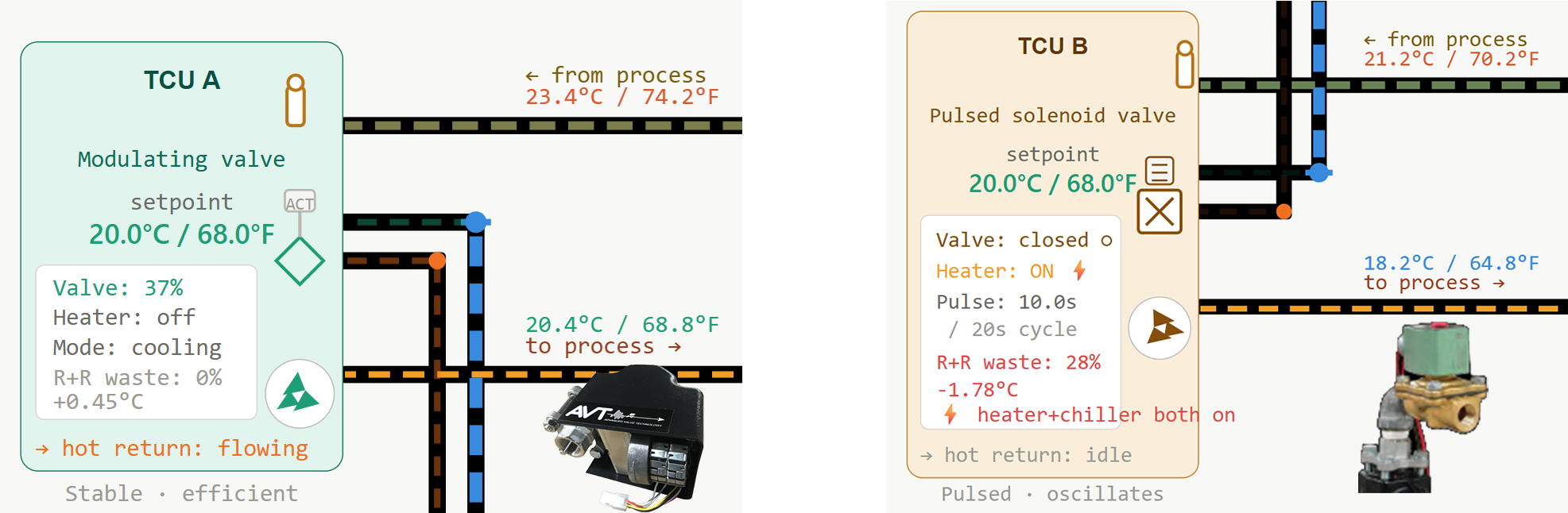
Chiller TCU animation: TCU A modulating valve vs TCU B time-proportioning pulsed solenoid valve.
TCU A — modulating valve — temperature vs time
TCU B — pulsed solenoid — temperature vs time
Resets to start-up conditions — mold at 23°C / 73.4°F, both valves closed
Supply (controlled temp)
Return (warm from process)
Chiller cold supply
Cold inlet (unvalved)
Hot water return to chiller
R+R waste = reheat energy × 1.3 (reheat + recool at COP 3), heater-triggered events only
Pump (centrifugal)
Temperature probe & bulb
Modulating valve + actuator
Solenoid valve
Simulation basis (middle-ground parameters) —
Pump: 35 GPM · Circuits: 6 × 0.375″ dia. × 15 ft ·
Volume: π×(0.1875″)²×6×180″ ÷ 231 in³/gal = 0.52 gal ·
Transport delay: 0.52 ÷ 35 = 0.89 s ≈ 9 ticks @ 100 ms/tick.
Supply setpoint: 20°C · Process heat load produces a 3°C ΔT, so return water enters the TCU at ~23°C.
TCU B — time-proportioning pulsed solenoid: Standard 20-second cycle time. At the start of each cycle the controller measures the error above setpoint and calculates a pulse width proportional to that error (gain = 80 ticks/°C, min 1 s, max 10 s). The solenoid opens for that duration then stays closed for the rest of the cycle. Because cold water takes ~0.9 s to travel 15 ft to the probe, cooling continues ~0.9 s after the valve closes — routinely pushing temperature below setpoint. When the drop exceeds 1°C the heater fires simultaneously with the chiller: the source of R+R waste.
TCU A — modulating valve with PI control: The valve opens continuously in proportion to the error (P term). A pure P-only controller would reach a stable equilibrium slightly above setpoint — called proportional droop — because some positive error is needed to keep the valve cracked open against the heat load. The integral term (I) eliminates this by accumulating the residual error over time and slowly nudging the valve position until the error reaches exactly zero. This is why TCU A locks at exactly 20.0°C while TCU B oscillates around setpoint.
TCU B — time-proportioning pulsed solenoid: Standard 20-second cycle time. At the start of each cycle the controller measures the error above setpoint and calculates a pulse width proportional to that error (gain = 80 ticks/°C, min 1 s, max 10 s). The solenoid opens for that duration then stays closed for the rest of the cycle. Because cold water takes ~0.9 s to travel 15 ft to the probe, cooling continues ~0.9 s after the valve closes — routinely pushing temperature below setpoint. When the drop exceeds 1°C the heater fires simultaneously with the chiller: the source of R+R waste.
TCU A — modulating valve with PI control: The valve opens continuously in proportion to the error (P term). A pure P-only controller would reach a stable equilibrium slightly above setpoint — called proportional droop — because some positive error is needed to keep the valve cracked open against the heat load. The integral term (I) eliminates this by accumulating the residual error over time and slowly nudging the valve position until the error reaches exactly zero. This is why TCU A locks at exactly 20.0°C while TCU B oscillates around setpoint.

What makes Advantage Engineering different
Advantage Engineering is the only TCU manufacturer that:
The hidden cost of pulsed cooling
Energy is being consumed on both ends simultaneously. This is what engineers call reheat and recool waste, and it adds up.
See it for yourself
The animation runs both approaches in real time.
Watch for:
Hit the “Restart Simulation” button at any time to watch the start-up sequence again from cold mold conditions.